Episode Transcript
[00:00:00] Speaker A: I left the Hesston estate atop Beverly Hills and walked back into the real world. An America living and breathing in fear. In your mind, you imagine somebody who might break into your house to harm you or your family.
What does that person look like?
[00:00:17] Speaker B: You.
[00:00:17] Speaker A: Me.
[00:00:18] Speaker C: Her.
[00:00:18] Speaker A: Her. Him.
[00:00:19] Speaker C: Really?
[00:00:19] Speaker A: Camera guy? Anybody? There could be a gun in the camera. I don't know. Where gun sales were now at an all time high. Can shoot as fast as with a semi automatic.
And where in the end, it all comes back to bowling for Columbine.
Welcome to outside issues with Audrey and Patrick.
[00:00:46] Speaker B: I might have to take a hit off my vape for stress relief and I think you understand that one.
[00:00:52] Speaker A: Yeah, that would actually add some cool visual texture to the show for our YouTube listeners watchers.
Two days ago, we were chatting on the phone kind of just after it happened, but Charlie Kirk was shot by a sniper while he was speaking in an event at a university in Utah.
It was called. Yeah, Utah Valley University.
Utah Valley in Orem.
That's a Mormon sounding town name. But yeah, September 10th. So, you know, a day earlier than 9 11. It would have just been a little too on the nose to have, you know, something scary like that happen on 9 11. But yeah, we have the benefit now of it, of it being about 48 hours and they've apprehended like the alleged perp who is a.
Yeah, just a. A guy who would like, who looks as though he's Charlie Kirk's target audience.
22 year old Tyler Robinson.
[00:01:59] Speaker B: Yeah, he looks a little bit like Charlie Kirk, if I'm not mistaken.
[00:02:05] Speaker A: Yeah, I was like joking to myself darkly.
He's like Charlie Kirk's Looper. Do you ever see that movie Looper where the different versions chase each other through time?
[00:02:16] Speaker B: I haven't seen that version. Sorry, I'm getting situated.
[00:02:19] Speaker A: When we talked about it, there was no joy in this news.
Horrible thing to watch.
A guy who's roughly my age or like within a stone's throw of my age, just shot dead in broad daylight in front of hundreds of people.
You know, terrifying.
I believe his family was in attendance or if they weren't, they've now been privy to the images. And I saw the shooting and it was just grisly, horrible.
And Charlie Kirk for me has been a character in the leftist media that I consume. So I've never been like a turning points watcher, but I've always been aware of Charlie because he's kind of like, if you're consuming political media and you're on the right, you're gonna Be seeing a lot of him. And if you're just casually consuming political media without any ideological preference, you know, Charlie Kirk will have probably found a way to sneak onto your algorithm and.
[00:03:23] Speaker B: Yeah, yeah, the way that he sort of. I'm trying to remember how he came into my. Onto my radar, but he came onto my radar probably somewhere along the lines of like, when I was watching the Young Turks, when the Young Turks was like, not bad.
I'm pretty sure that I saw some clips of him say stuff about abortion. The, the, the. The way I got introduced to him was his stance on abortion. And of course, the jubilee videos is, Is how I, I kept up with him. And I, I think I continued to focus with him more on abortion than anything else, which is, I don't know, it's. It's kind that he has the fascist views he's a sycophant for. He was a sycophant for Donald Trump and that whole posse, and his views are just abhorrent. But the thing that I would follow him for or I would end up listening to him for is all about women's rights and abortion.
[00:04:39] Speaker A: The loudest anti Kirk voices I've been hearing from in these last couple days have been from women and friends that are, you know, friends on Facebook or Twitter that I don't hear from a lot about politics. And they definitely had something to say because of all the anti choice content that he propagated. And I just feel like for somebody who has made so much hay out of trying to take away women's bodily autonomy, women are going to have long memories about that and they're pissed, righteously so. And so, like, yeah, I feel like I've just been seeing a lot of. There's been two voices. There's been the voice trying to martyr him from the right and to try and kind of like make, make his death into like a, you know, using it opportunistically to further some kind of conservative political goal. And then there's been the other side trying to claw that back, just saying, you know, like, wait a minute, did you hear what he said about race realism or women's rights or any number of things?
[00:05:49] Speaker B: Yeah.
At first I thought it was Nick Fuentes who got shot.
I don't know why my brain went there.
[00:05:58] Speaker A: I would have preferred that.
[00:05:59] Speaker B: I would have preferred that, too, quite.
[00:06:02] Speaker A: Honestly, just for body odor control alone. I think that would have been good. Shot in the arm for humanity. The pit of the stomach queasiness that I felt, I mean, Sue Ann felt when it happened. And we've been talking about it. It's just the violence begets violence thing at the moment that the shot was fired.
I'm just gonna read the transcript. These were kind of like the last utterances of Charlie Kirk. Right up until the end he was doing.
His style of engagement was like a kind of like debate me performative, going on to college campuses and trying to, you know, either disprove other people's ideas or prove his own ideas. So an audience member asked him, do you know how many transgender Americans have been mass shooters over the last 10 years? Kirk said, too many.
And the same audience member said, went on to say the number's five, and proceeded to ask Kirk if Kirk knows how many mass shooters there have been in America over the last 10 years.
Kirk says, counting or not counting gang violence.
Seconds later, the sound of a pop is heard and the crowd screams as Kirk gets shot and recoils in his seat. I'd just like to also read a quote by Charlie Kirk at a Turning Point USA faith event in 2023.
You will never live in a society when you have an armed citizenry and you won't have a single gun death. That is nonsense. It's drivel. But I think it's worth it. I think it's worth it to have a cost of, unfortunately, some gun deaths every single year so that we can have the second amendment to protect our other God given rights. That is a prudent deal. It is rational. Nobody talks like this. They live in a complete alternate universe.
[00:07:40] Speaker B: I heard the same thing said by somebody else a long time ago in 2012 about Sandy Hook.
[00:07:46] Speaker A: The first exposure that I really had, my millennial generation to this kind of like insane gun fervor and bloodlust in America was the Columbine shooting when I was in.
I think I was 13 or something like that.
[00:08:06] Speaker B: Were you at MBMS?
[00:08:08] Speaker A: I was at Adams.
[00:08:10] Speaker B: Adams, okay. That's right.
[00:08:12] Speaker A: I love so much, by the way, that we've got like our high school story that we're bringing along with us.
[00:08:18] Speaker B: I remember being 11 and in like my sixth grade class that was just brand new, designed by a guy who designed a prison.
Anyway, I remember hearing about it and seeing it on tv. I don't know why they put it on tv, but I remember like, oh, well, this is bad. And then from then on, it was like school shooting, school shooting, school shooting.
[00:08:42] Speaker A: I mean, we've been stuck here. I mean, I think that's like. If there's anything we can impress with this episode, it's that this is just a cycle that just keeps going and going and going.
[00:08:53] Speaker B: I don't know if you saw the.
Did you see the full. On the moment of his death, the graphicness.
[00:09:02] Speaker A: I'm glad I can say that I didn't have any choice about whether or not to see it. I opened up my Instagram app around the time that we spoke a couple days ago, and the very top video on my feed was the Moment of impact. And so I watched it and it was horrible.
[00:09:18] Speaker B: It makes me wonder what or who the Charlie Kirk on the left would be.
[00:09:24] Speaker A: Well, Hasan Piker was supposed to debate him in about a month.
[00:09:27] Speaker B: That's right.
[00:09:28] Speaker A: Why did I.
Yeah, yeah. And he gets threats in his life all the time. And they're, you know, I think Politico talked to him on the day that it happened.
And, like, you know, one thing I've noticed, I haven't been able to watch as much media as I like to these last couple of days, but to the extent that I've heard takes from, you know, for like, Emma Viglin, for example, or Hassan, like, this was a peer of theirs, you know, this was like somebody that they vehemently disagreed with and they'd make fun of them all the time. But there's something that hits kind of close to home, you know, when you're in the business of, you know, what do you want, what do you want to call it? Whether you want to call it propaganda or infotainment or journalism, you know, that like, I don't know, we're all. We're all getting the feeling more and more that you just can't go outside, you can't go in public.
[00:10:23] Speaker B: Yeah. And that creates just mass hysteria and mass paranoia. And if we're talking mental illness, it creates even more paranoia for those who suffer from paranoid delusions.
[00:10:39] Speaker A: Trump did a Oval Office address on the 10, on the 10th when this happened, and, you know, basically declared war on dissenting opinion. You know, people, you know, if you're not. If you're not with us, you're against us. And kind of like before, before Charlie Kirk was cold, basically just, you know, saying that we're going to use this to kind of mobilize, just doing essentially what he'd already promised he would do in places like Chicago and what he has been doing in LA and just kind of sending in the cavalry, you know. But I think, like, that seems to have cooled a little bit since the identity of the killer is revealed. And it turns out it's not a transgender antifa, you know, but Somebody who's, you know, at least in the vibes, is more aligned with, like, the conservative camp.
You know, the jets seem to be cooling a little bit, but I think, like, we're just concerned at all times about, like, how far somebody's going to take it.
[00:11:50] Speaker B: How far is anybody going to take anything at a grocery store, at a gym, at a.
I mean, a government building? You can't. But I feel like somehow somebody would be able to do something in a government building anywhere.
And I feel like we've all gotten desensitized.
For me, I feel like we got desensitized in the mid 2010s, and then since then, it's just sort of been downhill.
We haven't really addressed it in a way that is productive or even noticeable.
It's just been. My partner was actually sort of, like, very frustrated earlier this morning. He said there was a school shooting at, like, I think a middle school, or it was a school shooting. Who knows anymore what. What type of school? But it was on the ticker, and he was just like, I'm so pissed that this school shooting was on the ticker. And Charlie Kirk was number one.
And I'm like, yeah, that's like. That's how it goes now.
Like, it used to be, you know, oh, shots fired, heard out and say, like, Vermont or something. At a school in Vermont. And then suddenly, cnn, msnbc, Fox, all the corporate media entities are suddenly descending upon that little school in Vermont.
Now it's.
Now it's just maybe like, one reporter over there. Oh, hey, you know, we got. We have a school shooter that's been apprehended. A couple people died, A couple people were injured.
[00:13:39] Speaker A: Yeah, it's 20, 25 September. So Kirk's shooting was the 46th school shooting because it was on a campus. So it was the 46th so far this year.
[00:13:50] Speaker B: The thing that's really irking me is the response from the left, the response from the Democrats.
[00:13:58] Speaker A: They're connected.
The way that he died and the way that he lived were in direct conversation with each other. And so if we hope to not repeat this kind of thing or if we hope to really address the root causes, then we just have to call it like it is. And there was somebody on MSNBC was fired.
Yeah, we're saying some strong words about Charlie Kirk.
[00:14:24] Speaker B: What did you think of that sentence, by the way? I was going to ask you, like.
[00:14:28] Speaker A: Political analyst Matthew Dowd was fired from his position at MSNBC after comments he made following the fatal shooting of conservative activist Charlie Kirk during The coverage of Kirk's shooting, anchor Katie Turr asked Dowd about the environment in which a shooting like this happens, to which Dowd replied as follows.
He's been one of the most divisive, especially divisive younger figures in this, who is constantly sort of pushing this sort of hate speech or sort of aimed at certain groups. And I always go back to hateful thoughts lead to hateful words which then lead to hateful actions. And I think that is the environment we are in. You can't stop with these sort of awful thoughts you have and then saying these awful words and not expect awful actions to take place. And that's the unfortunate environment we are in. Yeah, I mean, there's not one inappropriate thing in that.
[00:15:12] Speaker B: My partner and I are constantly saying, there's going to be a civil war. There's going to be a civil war.
[00:15:18] Speaker A: Yeah. Or we're already in one. I think, you know, the appeal of antifa is that it's a show of power and it's a show of strength on behalf of marginalized people who are the primary targets of fascists on the other side. The liberal kind of stance for so long has just been.
It hasn't been coded powerful, it hasn't been coded strong. It's just been a kind of like very low energy, even tempered, you know, kind of placating of the other side, the other side's viciousness.
[00:15:53] Speaker B: I should probably not. I don't identify as Christian whatsoever.
I do identify as spiritual and I.
[00:16:01] Speaker C: Do.
[00:16:04] Speaker B: I suppose I believe in a, a Christ like figure back in history who, who, who influenced current spirituality and throughout the ages.
I gotta think more Jesusy.
I feel sometimes I gotta think more.
I gotta think more Jesusy because what, what would, what would Jesus do in this situation?
And then I think, would Jesus be an antifa?
[00:16:37] Speaker A: Like maybe the solution to this will not come from winning a debate in the marketplace of ideas. So it's going to need to be some kind of fight. I think the question is, how can we have that fight while not losing our values and kind of losing our humanity to fight our enemy in such a way that doesn't tear everything to pieces?
[00:16:58] Speaker B: The phrase tearing to pieces just flew back to that video.
I mean, I don't think I've, I've mentioned this is not on. Well, it's not on like a political spectrum whatsoever, but I don't know if I've mentioned that. I also have what my psychiatrist calls a touch of ocd.
And the way it manifests is so bizarre. It manifests in me having to watch graphic videos over and over and over and over again in, in counts of seven.
So it's like I would watch. It's like, 1, 2, 3, 4, 5, 6, 7.
Saw it. Okay, that doesn't feel right. So I have to watch it seven more times. Oh, did I see every single detail in that? Seven times. Okay, now I have to watch it seven more times.
My. I don't want to watch this.
I don't want to watch gore. I hate gore. I, I, I'm, I'm disturbed by. It gives me nightmares.
Luckily, this didn't happen with this video for some reason.
[00:18:09] Speaker C: Good.
[00:18:11] Speaker B: Unfortunately, it usually happens with stuff with animals, and I don't know why that is, but, yeah, luckily it didn't happen with this, with this incident, I was able to see the footage and not go into counting in sevens.
[00:18:30] Speaker A: Yeah, I'm glad for that. I didn't watch the the Hasan Reacts clip, but what I will say is it just reminded me of my own fragility.
I mean, you know, in the way that, I mean, like, I had a visceral reminder of my own fragility when I had my big accident a couple years ago and just broke my body and rock climbing. But I think just seeing somebody get shot in the neck like that and bleed out.
He was 31, you know, a bit younger than me. And.
Yeah. And I mean, like, I, you know, I mean, I did. I have felt some gratitude.
This has been a very stressful few days for me, and I've had a lot of dark thoughts, but I'm just so happy I have one more day to not be Charlie Kirk. It's great.
What was your experience of watching the movie? Like?
[00:19:21] Speaker B: It was suspenseful, a little bit confusing, especially since Joaquin Phoenix and Pedro Pascal look similar.
[00:19:29] Speaker A: They could be brothers.
[00:19:31] Speaker B: They. They could be. Yeah. And I was getting a little confused on, like, which side who was on which side, like, who who, like, endorsed which cause and which who didn't.
So, you know, and then, like, who got murdered and then, like, who, what cause they represented? So it got me a little bit confused, but, like, I really enjoyed it.
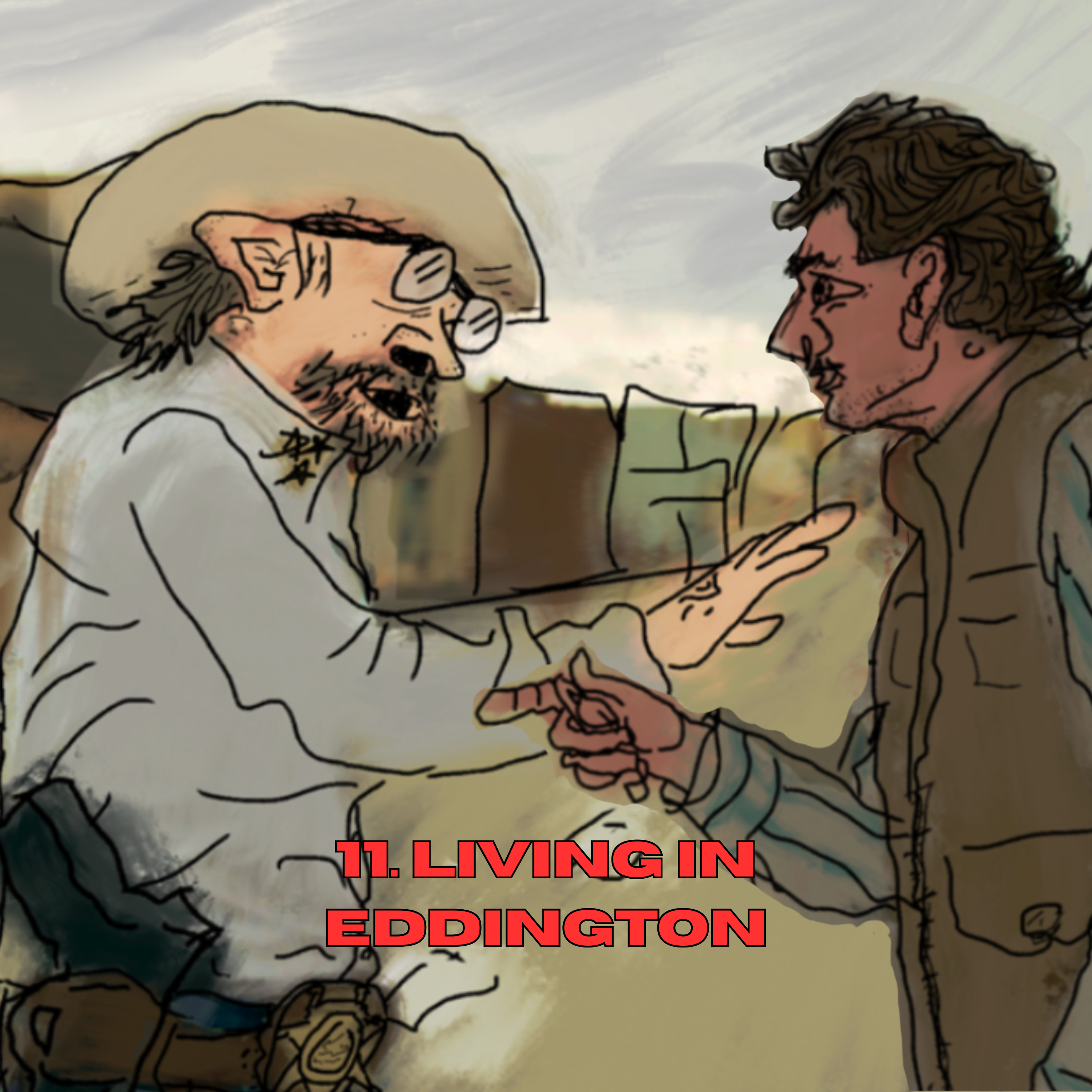
[00:19:53] Speaker A: So it's about a small town named Eddington in New Mexico. It's on Indian land, I guess.
[00:19:58] Speaker B: Just reservation law enforcement.
[00:20:01] Speaker A: Right. There's some jurisdictional, like, overlap between, like, the, you know, the native law enforcement and then the local sheriff. Joe Cross is the name of the sheriff played by Joaquin, who decides to run for mayor. And then Ted Garcia is, you know, the, the other contender, and they're both kind of Representing, like, the liberal and conservative silos in the culture war and in, like, the political contest. There's a corporation trying to build an AI data center on this land, which would siphon off a lot of the natural resources. Covid has already begun, or there's been the outbreak, and there's some public health ordinance in the city where there's, you know, masking is required in public. You know, there's the six feet of social distancing. I think the very first scene that we meet Joaquin Phoenix, he's just parked, you know, in the desert, just texting his wife, and he has, like, a squabble with some of the other, you know, Native American cops about whether or not he should be masking.
And I think, like, what really kicks things off is that there's this tension in the township about the masking, you know, or about the COVID ordinances. And whereas initially, like, Joaquin Phoenix is trying to fairly adjudicate, you know, between both sides, are kind of like, being somewhat impartial, representative of the law, and, you know, making sure everybody feels safe when they go to the grocery store, making sure that fights don't explode in, you know, between pissed off and frightened residents. He wants to impress his wife, essentially, or he wants to kind of, like, feel important, you know, like, he's. He's in this marriage, and she seems a little bit like one foot out.
[00:21:44] Speaker B: Oh, she's checked out. Yeah.
[00:21:46] Speaker A: He probably gets this idea to run for mayor because he feels like it'll raise his stock in his house and, you know, or in town. And so, yeah, he puts his thumb on the scales, coming from the conservative point of view. And he decorates his truck with all of the hard right, flashpoint kind of slogans.
[00:22:04] Speaker B: Fun fact. I saw somebody drive on the freeway, like, up here with that sort of garbage.
[00:22:10] Speaker A: The vehicle as collage.
[00:22:12] Speaker B: Yeah. With the huge American flag. They're just zooming down the freeway, and then they got pulled over.
[00:22:17] Speaker A: I'm sure you're like me. And whenever you see one of those parts at, like, the grocery store, you just take a picture. This is an important cultural document. Somebody should take a picture of it.
[00:22:25] Speaker B: Absolutely.
[00:22:25] Speaker A: First significant part of the story is about this contest between the two men. There's the liberal and the conservative. His wife falls for a. I don't know what you would call him. Some, like, kind of, what I like.
[00:22:36] Speaker B: To refer to them as misinformation hippies. And there's quite a few, like, health misinformation. RFK is quite the leader of that movement.
[00:22:48] Speaker A: Russell Brand would be more of this guy's vibe a little bit.
[00:22:51] Speaker B: Yeah. Oh yeah, yeah, yeah.
And there's quite a few out here. Like, especially on sort of like the island areas where there's a lot of anti vax and there's a lot of, you know, Covid was a hoax. Like, you know, everything is being created to control us. Everything is being created to harm us or something like that. We must fight using, you know, whatever higher power there is not like there isn't a higher power. But like these folks truly believe that there's, there's powers at B that truly don't exist.
Powers that be that create this chaos. And then they, they use their time to create chaos with different sort of.
[00:23:42] Speaker A: Pseudoscience and in this case, I mean, I think installing themselves as like the new authority. So it's like it's a disrespect of our skepticism towards authority and these kinds of like anti establishment narrative, cleverly they become the new totem that ought to be worshipped. And I think his story has something to do with sex trafficking. His dad was powerful and he was kind of in league with some powerful people and he managed to escape, you know, the trafficking. Emma Stone, who plays Joaquin Phoenix's wife and then him is she had this experience and she's either not believed or the. Her experience is co opted, you know, for cynical purposes by him. Like he starts at one point he says that, you know, because his wife had been on a date with Ted Garcia, the Pedro Pascal character years ago, that, you know, and in fact he like assaulted her and that, you know, and I think that's, that's like the real like straw that broke the Campbell's back with them is that, you know, when he, once he starts cynically using her story for electoral purposes, everything falls apart. Which, fair enough, I say that's, I.
[00:24:56] Speaker B: Think how the, how they get you, how they get people like save the children, the children are being abused and like, you know, there are people who have been abused as children. Obviously I work with a lot of them, but it's like that's sort of the hook is the children are being harmed.
Let's join this movement that has really nothing to do with saving children except for maybe anti vax stuff.
So that's what I noticed about that sort of dynamic of her being assaulted and then having that outburst of like millions of kids are being hurt.
And I think that's just how those like crunchy misinformation conspiracy people will get you is Save the children.
[00:25:48] Speaker A: From the beginning of the Movie every. Everybody's on their phones and everybody's scrolling and every. And the world contained in your phone. I mean, it's different from person to person. You know, it's like we see that. It visualize that paradox of, like, you know, you're literally. You're connecting to the whole world through this little rectangle, but you're alienated from the person sitting next to you. The wife is in her little bubble. Her mother is in a bubble. I really like the right wing conspiracy briefing that she gives them every morning over coffee, you know, while he's getting ready to go out and do his day of sheriffing. You know, she's shoving the laptop in their face and, you know, like, can you believe, you know, this meme on my Facebook? There's almost something a little, like, tragic or poignant about the fact that it seemed like when we first meet Joaquin Phoenix, he doesn't have any firm commitments. You know, he may have some predisposition towards, like, this right wing craziness.
We see he's got his father, who was the sheriff before him, framed, and there's this photo that's framed in the house. Like it's the Buddha or something. You know, like, he's just this religious significance to the dad's photo. He becomes kind of just increasingly evil as the story goes on.
[00:27:05] Speaker B: I had a little bit of a hard time figuring out how right wing he was. Like, I knew that he was right wing, but it was a little hard to figure out, like, gauge the level of it because, like, Trump isn't mentioned that much in. In this. Yeah, so.
[00:27:23] Speaker A: And barely at all.
[00:27:24] Speaker B: Yeah. The only thing I remember seeing is that that dystopian ass photo of him holding the Bible in front of the church after all of the cops dispersed the BLM protesters with tear gas. That was the only thing I saw. So, like, it was a little bit like, okay, so you're right wing, but there's no Trump. So now it's like, you know, we're. We're in a. We're in a world now where it's no right wing, just right wing. It's just Trump.
[00:27:55] Speaker A: Gun to my head, that is a shortcoming of the film. I feel like I understand why they did it. I understand why they left Trump himself so much out of it. Because it's trying to get at, like, the mania underneath Trump, and it's trying to look at, like, these broader cultural and political swirls and eddies, you know, that, like, Trump was just an opportunistic agent, you know, who came in and he kind of, like, harnessed these. These things and he became kind of like this vector through which a lot of the conflict ended up happening.
So I think, like, I understand why he was left out of it, but he's also so central. Like, it's.
He's both a symptom and a cause, obviously.
[00:28:42] Speaker B: I was very shocked at just when Joe starts going on the killing spree. The masked people, those were. That's antifa, right?
[00:28:53] Speaker A: Yes, yes.
So they are antifa super soldiers, I think, is the idea. They're responding to the. The death of Ted Garcia. So at a certain point, I think one of my favorite scenes in the movie is when Joe's wife leaves him for the Russell Brand guy, and he's.
He's just kind of in bad odor everywhere. And. And so he goes to a big campaign party, you know, on the liberal side of town, and they're blasting Katy Perry's fireworks.
[00:29:27] Speaker B: That was great.
[00:29:29] Speaker A: Yeah. And they have this. There's this great, like, kind of emasculated moment for Joaquin Phoenix where he just keeps turning the radio down on the. On, you know, the boombox. And then, you know, Pedro Pascal just keeps turning it up and then slaps him in front of everyone and just, you know, just fully emasculates him. And then, yeah, he shuffles off. And I think, like, he makes a stop after that.
Makes a stop to murder the homeless man, you know, who's been causing a ruckus in town, and dispose of the body. And then upon disposing of the homeless guy, he murders. He takes out his political competition with a sniper rifle and then blames it on the. The leftists in town, the kids.
[00:30:17] Speaker B: And kills his son.
[00:30:19] Speaker A: Yeah, kills his son as well. So. God, I'm such a bad person. I don't even remember the son.
I'm just like, oh, yeah, there was a. There was a kid standing there, whatever.
[00:30:29] Speaker C: Yeah, yeah, yeah.
[00:30:32] Speaker A: But, yeah, no, that took a turn. I knew something significant was going to happen after that moment. Like, how could you not think that? But I. I think that's a credit to the movie, that it just kind of, like the violent, the violence managed to be pretty shocking, you know, and.
But looking back, all the seeds had been planted for that, you know, from the beginning of the movie. And, like, I was going to say, like, isn't there. There's a dynamic, I think, with mass shooters or all these kinds of, like, psychopaths. Their wives tend to leave them.
Like, right around that time, there's like, the white man, recently divorced, you Know, and feeling a little lonely.
[00:31:11] Speaker B: I was thinking about the Las Vegas shooter from 2017.
I don't know if he had that sort of dynamic going on, but I.
[00:31:20] Speaker A: Specifically thought of him, actually. Like, I think you and I. Yeah, same page. One of the biggest laugh lines, just to kind of like, to speak to, like, the. The liberal point of view as represented in Ted Garcia. There is a campaign commercial where he. As part of his story is. It's a. It's a Joe Biden kind of story where, like, he. His wife died tragically, and he's been forced to. You know, he's been like, a widow or widower, you know, just raising their son. And there's a kind of, like, bloodless and, like, cynical, sappy quality to, like, his campaign commercial that just made me laugh because of how, like, specific the calibration was of all. Like, you know, the music, you know, the way it was edited, and, you know, the performance of Garcia in the video. But, like.
And then, you know, you see. So you see the public facing Democrat, and then you see the way that he acts in his house, and, you know, there's definitely, like, a kind of narcissism to it and, like, a pomposity and, like, you know, the way he acts towards his son. I don't know. What did you think about that scene where, like, he. He confronts his kid trying to go out with the car and, you know, because I think you could look at it two ways. I mean, in a sense that this is an argument that happened over and over during COVID about, like, how hard should we be in each other? About, like, the protocols, you know, and how much empathy should we have for how each of us is, you know, struggling through this?
It was. Yeah, it was an interesting scene.
[00:32:53] Speaker B: I think it was. It seemed like a lot of it was rooted in pain about the mom.
That's what I picked up on.
Because he's a single parent. He doesn't have another parent to help him out with this type of situation, especially in the middle of a pandemic.
So I think that his response was definitely related to the mom's absence.
[00:33:20] Speaker A: That's so astute. I didn't even pick up on that. But I think you're right. So let's move to the kids.
There's.
There's an amazing kind of, like, parallel. I would say, like, near equal in significance to, like, the big war between, you know, the. The two sheriffs or the sheriff or the mayor's to be.
Is there's the kids living under Covid. There's a kind of like, you know, blm, more of like a radical left kind of like, you know, grassroots upswell. There's a girl who spearheads it and she's got two boys kind of vying for her affections. And one of them, I think, like he would believe in anything if she would just go out with him. And so he's kind of. He's kind of just like going whichever direction the wind's blowing.
But it's like you said, you know, the way you and I experienced, you know, the blm and you know, George Floyd was like, in these cities, you know, that we were a lot closer to like the nexus of where like all of the organizing was happening. And in Eddington, we get to see kind of like, well, how does that ripple to like the.
Into the boonies, you know, where people still feel some kind of connection to like this American story, but they're just kind of like, they're. They're like pantomiming like a kind of relationship to it. And the way I looked at the, the whatever, like jokes seem to be made at like the kids expense or burgeoning leftist expense, I felt like it was done with, with some affection fumbling towards, you know, like, well, how do. How do we.
[00:35:04] Speaker B: How do we go about this?
[00:35:05] Speaker A: How do we do the social justice game?
[00:35:08] Speaker B: How do we change the world, like, through this very small lens of. Of our town?
[00:35:14] Speaker A: Whatever thought in your head got you moving, you know what I mean? It's like, it's the direction your feet are going that really make. That really make you who you are. And I feel like a lot of people, they find themselves in protest. They find them on themselves on a side of an issue.
And you know, there's going to be a lot of. There's going to be a lot of self interest that brings you there, you know, there's going to be some ego that you're just inevitably going to bring to the fight, you know. But like, I think the fact remains, it's like you're out there with the sign, you're in the town square, you're, you know, trying to stop a police car from going in a direction. You know what I mean? Like, in my view, you know, you're on the right side of things. And as inelegantly as you are expressing yourself, you're putting your body out there. And to me, it's like, you know, you're being part of the solution.
[00:36:00] Speaker B: That's what I would do. I mean, given the chance, if I wasn't in an office. Right now, I would definitely put myself between a cop car and a protester. Now ICE is going to be doing more raids in la.
[00:36:14] Speaker A: Yeah, right. Because of the Supreme Court decision where they can now, in the letter of the law, that they can racially profile people.
They always racially profile people, but it wasn't codified, and now it is. And, you know, Kavanaugh's opinion was just abhorrent. This show is half la, so it pertains to us.
[00:36:34] Speaker B: Yeah. I saw on my way to work today, I saw a big truck with another huge American flag on the side of the car. It said Leo.
[00:36:43] Speaker A: What does that mean?
[00:36:44] Speaker B: Law enforcement officer.
[00:36:46] Speaker A: Oh. And it was just on a truck or like, just like, on a F150 or something?
[00:36:49] Speaker B: Yeah, it was just like, on a. On a regular old truck.
Going back to, like, the trucks in. In. In Eddington and Joe's truck with all of the. The pomp and circumstance, all the decorations.
I don't know. For some reason, that made me sad.
It made me very sad. And maybe this is just like a me thing, but when somebody tries really hard and you see it visually and then they, like, lose and, like, their character goes completely berserk, that just makes me sad. I don't know why. It's like a weird human thing. I have.
[00:37:29] Speaker A: I heard something recently really resonated with me. People like to feel like they have control over their own lives, and they also like to feel like they have secret knowledge. They like to feel like they know something.
It's why we always talk about, you know, the common thread connecting all these problems. It's capitalism and which disempowers people.
It's. It's. It's not a democratic process. It's not a unifying process. It's like, you know, these meta narratives that come up. A lot of the conservative boogeymen are straw men.
[00:37:58] Speaker B: My view of law enforcement and my personal experience with law enforcement, I think Joe's character kind of put things in a little bit of a different perspective for me, because especially just, like, the stuff with his wife.
Just that. That longing of, like, wanting to be close to the person that you're. You're with and, like, that. That just that longing to, like, be connected to somebody and to have a baby. And to have a baby. Yeah. I don't want to say, like, cops are people, too, but, like, you know, it's. It was just a. It was an interesting experience knowing, like.
Like flashing back to the atrocity of the LAPD that I've seen Versus like this kind of like sentimental experience.
[00:38:49] Speaker A: The characters in Eddington, they're all puppets dancing on someone else's strings.
And, you know, the last shot of the movie, it's. It's literally the AI data center has been built almost like embryonically connected to the town. It's siphoning off the energy and the spirit of the town.
It's like the whole movie's kind of like wrapped up in that image. After his heroic standoff with Antifa, you know, like, you know, in the course of which he was paralyzed, Joe Cross is, you know, he becomes this hero and then the data company or the, you know, venture capital firm is able to kind of use him as their puppet. It's not sympathetic to all parties, but I feel like it's empathetic towards them. And it's very much a cross section of where we are now. Socially fragmented and, you know, politically disempowered.
[00:39:35] Speaker B: It was a really great watch to, to sit down and actually become enmeshed and I hope you have a great time out of the country. It sounds like such a fun trip.
I'm sorry that this situation happened right before you were supposed to go, but otherwise get some. Get some relaxation, you know, recharge.
Do a lot of deep. I would suggest do a lot of deep thinking, a lot of deep meditations. Ask your higher power for answers. Not ask. Sorry, I'm. I feel a little bit preachy. But instead of asking your higher power for an action to do or for something, just ask the higher power for an answer. Ask it a question, get an answer and see what to do with it.
[00:40:31] Speaker A: I've been feeling restless, irritable and discontent lately. Yeah, a lot of us do. This is just the new normal. So we're not alone. You take care.
[00:40:41] Speaker B: All right. Bye. Have a good trip.
[00:40:43] Speaker A: Thanks, Audrey.
[00:40:43] Speaker C: All my strangulated fantasies Lie dormant on the shelf they waited there too long for me While I was not myself I, I was really tired When I opened Fireland and didn't have a chance to think I was out of time and every line got farther out of sync It's a curious condition I don't know what to do no open minded social theories Seem to pull me through I'm sick of life on credit and I'm tired of paying dues but looks like there's no other choice to choose how can you win?
How can you lose?
Looks like there's no other choice to choose Never make the headlines and you'll never make the news when you've got no other Choice. Choose.
All my plans I've made I rolled away like a rug without a floor.
Things that were great helps to me aren't helping anymore. There's crisis on the Internet and a witness at my door.
Daily noise gets louder becoming harder to ignore mind is going 30 in a zone like 65?
Life is going by so fast it's locked in overdrive well, I'd like to slow it down a bit and put it in the cruise. But it looks like there's no other choice to choose.
How can you win? How can you win? How can you lose?
It looks like there's no other choice to choose.
You never make the headlines and you'll never make the news.
When you've got no other choice. Choose.
All my visionary concepts are just sedimentary dust. Just like that guy who once proclaimed he thought therefore he was like to dig down deep inside Horse street, the hill beyond but my inner stage drink the count as long since overdrawn. One day when this is over and it's time to lay me down Luck threw me a cannon Shoot me in the ground and if one guy would ask you why I never did refuse? Well, I thought there was no other choice to choose.
How can you win? How can you win? How can you lose? How can you lose?
Looks like there's no other choice to choose.
Never make the headlines and you'll never make the news.
When you've got no other choice. Choose.
How can you win? How can you win? How can you lose? How can you lose?
It looks like there's no other choice. Choose.
You never make the headlines and you'll never make the news.
When you've got no other choice to choose.
No choice to choose.
No choice to choose.
No choice to choose.